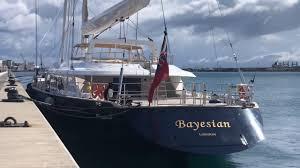
Bayesian Tragedy: Britain’s marine safety unit is a beacon of sense
The Bayesian tragedy will be investigated by the MAIB, an overlooked story of functioning, plain-speaking government
Monday August 26 2024, 12.01am BST, The Times
Aweek of speculation surrounds the fate of the superyacht Bayesian. Alongside the shock at seven deaths, respect for the courage and skill of rescue and recovery teams, awe at savage nature and irritation at conspiracy theories, the sailing community in particular has been anxious. It is always so: over half a century of offshore sailing (and personal timidity) I have shared many such conversations: over the 1979 Fastnet Race disaster, the losses of expert yachtsmen such as Mike McMullen and Alain Colas, the foundering of the tall ships Marques, Maria Asumpta and Astrid. The question is always pressing: why?
The extraordinary suddenness of a superb 184ft yacht sinking at anchor, while others nearby did not, started discussions: mast height, retracting keels, freeboard, portholes, bulkhead doors, crew routines? Rare is the yacht owner who didn’t start thinking about the heeling-and-righting angle of their own boat, probably under a sixth of Bayesian’s size. Big, beautiful sailing yachts don’t just sink in minutes. From the industry came rapid defensive accusations. Giovanni Costantino, chief executive of the company that built the vessel, promptly claimed a “list of human errors” and “procedures not followed”. Even the local prosecutor already dares to say it is “probable that offences were committed”. The fact that more crew were saved provokes, “why didn’t they rouse the sleeping passengers”, though anyone used to the pampering of billionaires might guess that instinct would make them hesitate, given the particular suddenness of this weather freak.
But we do not know and probably will not until the little ship is raised and forensically examined. I am grateful to suppose that this will be well done, because within a day Britain’s Marine Accident Investigation Branch (MAIB) sent a team to Porticello. This small, tough, expert unit within the Department for Transport should be better known and appreciated, so here goes.
The MAIB was founded in 1987. The sinking of the Herald of Free Enterprise ferry with the loss of 193 lives had made Mr Justice Sheen observe that it was “a bit strange” for an investigation to be run by the organisation responsible for that ship’s safety and certification. So the MAIB was formed to be independent: four teams of seasoned expert seafarers supported by naval architects and technical staff. Up to 70 times a year they analyse and report on accidents involving UK vessels worldwide, or serious mishaps in UK territorial waters involving anything from dinghy disasters to supertanker collisions.
Apart from its deep expertise three key qualities lie at the core of the MAIB mission to increase safety. It cannot be subject to legal or political coercion, it does not apportion blame, and almost alone among government bodies it writes its reports with deliberate clarity and simplicity. The least educated and experienced crew member should understand what happened and be part of preventing it happening again. Each report is a model of comprehensibility in an age of obfuscating jargon, partisanship and psychobabble.
It might deal with a fishing boat colliding with an oil tanker off Ardrossan, a rigid-inflatable shaking off tourists, a collision between jet skis or speedboats, a trawlerman’s arm being broken. It might explain why a tanker put Jetty 2 at Canvey Island out of use for weeks, or how two people died of carbon monoxide poisoning in a moored motor cruiser. Some involve death or injury, others financial loss: of course sometimes a legal case follows but that is not the MAIB’s business. It simply explains what happened in what order, and offers recommendations such as a recent one about the ladders used by pilots to board ships (worldwide, a big ship pilot dies every few months).
Taste the solid simplicity and sense of MAIB prose. Sometimes gaps in a changing world are drily pointed out: “The use of mobile telephones and other communications media is an increasing source of distraction on working decks and other hazardous workspaces on board ships, for which formal guidance is currently lacking.” It may remark that “previous accidents were not recognised as warnings”, or “the installation of the lifeboat davits was not in accordance with the manufacturer’s instructions”. There might be obvious human causes: “The pilot was highly likely to have been severely fatigued”, or purely technical ones: “The steering system failure was caused by an electronic steering control feedback potentiometer loosening due to vibration.”
Often the clarity is devastating: “No one saw the stevedore place himself in a hazardous position between the crane and the hatch cover, and the ship’s chief officer did not have a clear line of sight.” A man died. Sometimes experience is evaluated: among amateurs when “the knowledge and skill levels of the persons in control or overseeing the two craft were not appropriate to the manoeuvres being undertaken”, or professionals: “Training scheme weaknesses enabled the crew member to bypass requirements and gain promotion twice when he was not ready.” He died too.
Improvements are acknowledged, lessons learnt. The MAIB points no fingers: “The tractor unit driver was found to have cannabis in his system but this was unlikely to have contributed to the accident,” says one report, finding it more relevant that there was no barrier on a ramp between cars and pedestrians.
For all the tragedy I find comfort in reading these reports from experts: not scapegoating or theorising, but speaking from a cool, factual world far beyond the public and political maelstrom of blame and speculation. For those in peril on the sea the MAIB is as useful as the lifeboats. So Godspeed to Investigation 9503392: sailing vessel Bayesian.